Oral Language, Reading Aloud , Listening Skills, &Grammar
 

Third

Oral lang, writing, Third Grade Language Arts spelling

4030-01 Standard I: Oral Language_Students develop language for the purpose of effectively

communicating through listening, speaking, viewing, and presenting.

4030-0101 Objective 1: Develop language through listening and speaking.

a. Identify specific purpose(s) for listening (e.g., to gain information, to be entertained).

b. Listen and demonstrate understanding by responding appropriately (e.g., follow multiple-step directions, restate, clarify, question, summarize).

c. Speak clearly and audibly with expression in communicating ideas (i.e., effective rate, volume, pitch, tone, phrasing, tempo).

d. Speak in complete sentences with appropriate subject-verb agreement.

4030-0102 Objective 2: Develop language through viewing media and presenting.

a. Identify specific purpose(s) for viewing media (i.e., to identify main idea and details, to gain information, distinguish between fiction/nonfiction, distinguish between fact/opinion, form an opinion).

b. Use a variety of formats (e.g., drama, sharing of books, personal writings, choral readings, informational reports) in presenting with various forms of media (e.g., pictures, posters, charts, ads, newspapers).

4030-0403 Objective 3: Spell words correctly.

a. Use knowledge of word families, patterns, syllabication, and common letter combinations to spell new words.

b. Spell correctly grade level compound words, words with plural endings, and common phonograms.

c. Spell an increasing number of high-frequency and irregular words correctly (e.g., friend, square, special).

d. Learn the spellings of irregular and difficult words (e.g., electric, planet, trapper, rectangle).

4030-0404: Objective 4: Use spelling strategies to achieve accuracy (e.g., prediction, visualization, association).

a. Use knowledge about spelling to predict the spelling of new words.

b. Visualize words while writing.

c. Associate the spelling of new words with that of known words and word patterns.

Third Grade Language Arts Core 80

d. Use spelling generalities to assist spelling of new words (e.g., doubling of consonants, “le” endings, adding suffixes).

4030-05 Standard V: Fluency_Students develop reading fluency to read aloud grade level text effortlessly without hesitation.

4030-0501 Objective 1: Read aloud grade level text with appropriate speed and accuracy.

a. Read grade level text at a rate of approximately 100 wpm.

b. Read aloud grade level text with an accuracy rate of 95-100%.

4030-0502 Objective 2: Read aloud grade level text effortlessly with clarity.

a. Read grade level text in meaningful phrases using intonation, expression, and punctuation cues.

b. Read with automaticity 300 third grade high-frequency/sight words.

4030-06 Standard VI: Vocabulary_Students learn and use grade level vocabulary to increase

understanding and read fluently.

4030-0601 Objective 1: Learn new words through listening and reading widely.

a. Use new vocabulary learned by listening, reading, and discussing a variety of genres.

b. Learn the meaning and properly use a variety of grade level words (e.g., words from literature, social studies, science, math).

4030-0602 Objective 2: Use multiple resources to learn new words by relating them to known words and/or concepts.

a. Use multiple resources to determine the meanings of unknown words (e.g., simple dictionaries, glossaries, beginning thesauruses).

b. Relate unfamiliar words and concept to prior knowledge to increase vocabulary (e.g., rotation: planets, spinner, taking turns).

4030-0603 Objective 3: Use structural analysis and context clues to determine meanings of words.

a. Identify meanings of words using prefixes and suffixes.

b. Use context to determine the meaning of unknown key words (e.g., The ferocious dog growled at the children.).

c. Use context to determine the meanings of synonyms, antonyms, homonyms (e.g., blue, blew) and multiple-meaning words (e.g., light).

4030-07 Standard VII: Comprehension_Students understand, interpret
Reading Aloud Artfully

  1. Reading Comprehension: Picture Walk and Other Strategies

Tip: Teachers  read daily to their students for numerous reasons. It provides a model for rhythm and the structure of the story. It encourages the children to visualize and expand their vocabulary.  It exposes the children  to text which would be too difficult to read independently. It helps them become better writers. It  develops a thirst for independent reading. With discussion and directed activities, reading aloud to the children helps increase their knowledge base.

Cummins and Stallmeyer-Gerard  advocate using the read along time to develop the skill of synthesizing. Instead of just recalling facts they encourage their students to think about the big idea the author is trying to convey in non fiction stories. Here describes a teacher’s approach to Teaching for Synthesis of Informational Texts with Read-Alouds. The Reading Teacher March 2011

The teacher, Sunday, had a four parts to her lesson on synthesizing. First she explained synthesizing via an analogy of baking a cake. As the students listed the ingredients, she sketched images of the ingredients on the white board . She explained when you mix the ingredients and then bake them, they get a cake or a “synthesis of the ingredients.” She sketched a baked cake to reinforce the concept. She then took a story she read aloud to the students. She sketched the “ingredients” She put a plus sign between each  fact the author talked about.

After the students wrote their interpretation of their illustrations, of another  non-fiction story, the teacher chose four responds, with their approval, and displayed them via the overhead. She high-lighted the strengths and underlined the language that indicated synthesis.

The teacher then read aloud a new story related to the first story. She instructed them to think about the facts , “ingredients,” in  the text and how they blended together and how what they know and understand about a topic is transformed, like a cake. When the students did that they were thinking about the author’s message.

  1. TeacherRead-Aloud That Models Reading for Deep Understanding ReadWriteThink

  2. Reading Aloud to Build Comprehension/LDOnline

  3. Interactive Storybook Reading  for At-Risk Learners

  4. Read Aloud Lesson Ideas with "A Chair for My Mother" by Laurie Patslides 2/8/12

  5. Tell Me a Story (the star in an apple)Dr.   Jean

  6. Basic Storytime Lesson Outline/HubPages/PreSchool

  7. Popular Read to Me Books Great Books; Classics;

Antonyms and Synonyms


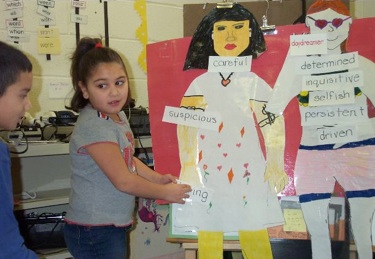
The characters Emily and Alice were drawn by a student in the class.

Since Emily’s and Alice’s personalities were so different, they lend themselves to augmenting the students sense of contrast as well as developing vocabulary via synonyms and antonyms.

After students compiled a list of characteristics for the two characters and placing the labels on appropriate character, the synonyms and antonyms were easily  aligned.  (Blank labels prepared ahead of time and applied to the laminated cut-out via sticky putty.)

  1. -Carl Smith in Reading aloud: An experience for sharing, lists the following reasons for reading aloud to students:

  2. -We want to explain and provide information about the world.

  3. -We want them to be curious and inquisitive and see language as entertaining and stimulating.

  4. -It motivates them to read it themselves and read other stories independently.

  5. -It stimulates and expands their interests and appreciation of varied genre.

  6. -Good literature gives children a perspective to help them evaluate the books they read independently.

  7. -Comprehension and vocabulary expands as their background knowledge about the world expands.

  8. -They discover the relationship between the oral and written language. Reading supports and encourages imagination to write their own stories in different genre.

  9. -At risk students can enjoy stories that are too difficult to read independently.

  10. -Carl Smith quotes a young boy who states why he likes to listen to stories. “If your eyes aren’t busy, your imagination is free to roam.” (Mendoz, 1985)

Reading aloud should be a regular part of the regular classroom schedule.

Story Telling

  1. Storybook Reading: Improving Vocabulary and Comprehension for English-lang. Learners. Pollard-Durodola, and Vaughn

“Elements of story read-alouds for English-lang. learners:

  1. 1.Introducing (previewing) the story and three new vocabulary words.

  2. 2.Reading a passage for a narrative or information text out loud, focusing on literal and inferential comprehension.

  3. 3.Reread the passage, drawing attention to the 3 voc. words

  4. 4.Extending comprehension, focusing on deep processing of voc. knowledge.

  5. 5.Summarizing what was read and any content knowledge that was learned.”

  6. Story ArtsOnLine -lessons and  activities for storytelling in the classroom

  7. Storytelling in the Classroom

  8. Storytelling as a Strategy to Increase Oral Language Proficiency  of Second Language Learners. Yale-New Haven Teachers Institute

  9. Children’s Responses to Storybook Reading /Seawright

  10. Storytelling Lesson Plans and Activities

  11. Language an Literacy: Storytelling Workshop/ A Place of Our Own

Model of a Read-Aloud

Designate a a time and place in the daily curriculum for reading aloud. Research supports 20-min.-period.

Select quality literature.

Read Literature that connects via genre, theme, or topic with other literature read.

Discuss literature in a thought-provoking way

Offer a variety of response and extension opportunities,viz, writing, drama, art or pair sharing.


“Commitment to a quality read-aloud experience, well-conceived and well- constructed, is needed before the maximum effects in language, literacy, and literature growth can be realized.”Hoffman and Roser, The Rdg Teacher March ’93


Caldecott books are a valuable source for language stimulation.

  1. 1.Read picture books aloud to the children. As you share pictures with the children have them predict what they think will happen in the story.

  2. 2.After reading a book aloud put it on a “sharing table.” Encourage children to work in pairs and look at the books while telling the stories to each other.

  3. 3. As children look at the pictures in a picture book tape record their version of the story and share later with a friend or the class.

  4. 4.Dramatize the story.

  5. “The art work in picture books give readers experiences they can get in no other way. There is much more to the pictures in a picture book than meets the eye.”

  6. Blair Lend, Caldecott medal illustrator

Guidelines for reading a storybook to young children:

Before Reading

        Show the cover of the book

        Read the title

        Encourage predictions

        Discuss the author and illustrator

        Give a brief summary of the story

During Reading

        Read in an expressive, dramatic voice

        Use pausing and voice inflection to invite predictions at appropriate points in story

        Observe children’s behavior to monitor their understanding of story

        Rephrase textual language if it seems children are not understanding

        Stop at appropriate points in story and encourage predictions.

After Reading

        Discuss/react to the story.

(Vygotsky (1978) maintained that children need to talk aloud as they think. For first graders especially, talk/discussion, is essential to thought and action until they eventually develop “inner speech.”)

        Look for opportunities to establish relationships between similar stories

        Engage children in activities which build on and extend the story.

Clay, M.(1991) Becoming Literate

Meek, M. (1992) On Being Literate

  1. U.of A at Little Rock RR /Literacy Support Program, 1994


The page on fluency and drama discusses the importance of  pair reading to follow the guided reading session. First graders especially need to hear their voice to develop confidence and in turn fluency.

Teacher’s Adventures in Wonderland ---a 4.5min. video of “.. jumbled fairytale/dystopian nightmare.

Importance of  Teachers Reading Daily to Their Students

" "The single most important activity for building the

knowledge required for eventual success in reading

is  reading aloud to children. "

Commission on Reading in a Nation of Readers


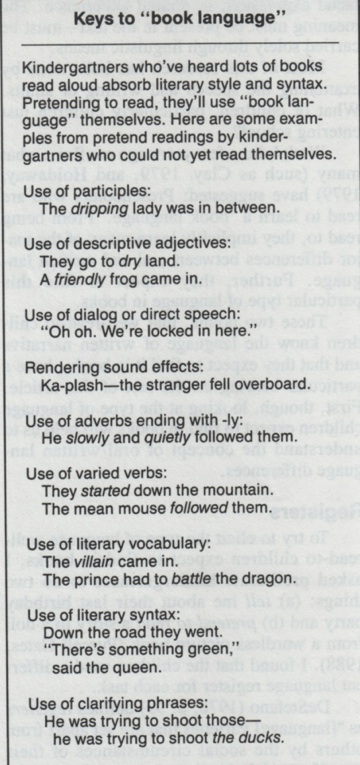
Reading to children introduces them to the language of books which is different from speech and conversation. Clay(1991) describes this as “book talk.”Through exposure to the language of books, children develop anticipatory systems for expecting particular structures to occur within written language. Margaret Meek (1992) explains how children “discover text and discourse in the sustained, cumulative building up of related episodes: how one thing follows and is related to another. The rhythms and structures of written sentences, the patterning of events, the conventions of story beginnings and ending are all significant features o written language which they learn without instruction.” (p.111). This knowledge about books provides children with a personal foundation for making meaningful predictions as they read stories on their own.”

Why Should I Do It?

A well-balanced literacy program should include opportunities for children to hear stories that they would be unable to read for themselves. The purposes  of a read-aloud component are:

        it provides a good model of fluent and expressive reading

        it provides opportunities for writing

        it provides opportunities for retelling

         it exposes children to a wide variety of story structures, genres, characters, and authors

        it increases children’s concept and vocabulary knowledge

        it promotes an enjoyable experience with books.


How Do You Do It?

In selecting a story to read to children, the book should be meaningful and predictable. The teacher should have previously read the story. The reading of the book should be interactive with the teacher inviting the children to make predictions as he/she reads.

6 Year Old Presses Mike on the iPad to go to Google for Information

Grandpa gave his six-year-old grandson, Matias, his old iPad. When Grandpa baby sits they look up information via Google. Recently they were talking about the sequence of the Star War movies. (There were six.) They were wondering which one came first. Without prompting, his grandson automatically pressed the mic on the iPad and asked, “ Which Star War movie was made first? Within seconds he received a response!!!!! Even his grandfather was amazed that his 6-year-old grandson remembered how to activate the mic plus how concise Matias’ verbal skills.  Of course they received the correct answer to question.

Most of the applications for the iPads have the mic for note taking. As children speak, their words are simultaneously typed on the screen. Instantly they see their verbal statements in print. Phenomenal!  Oh the possibilities for the mic and iPad are endless. However, everything in moderation. The iPad’s mic, dictation, and recording should be a reinforcement tool- not the initial stage of reading and writing.

At three, while playing with his train set, Matias carried on a pretend conversation with the engineer warning him there is a bridge out ahead.

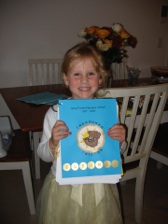
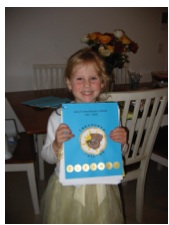
Eleanor in showing her book made in pre-school


Eleanor’s mother reading to her every night from a baby on, had a tremendous influence on Eleanor’s academic career.


When Eleanor was in seventh grade she won the district’s speech award for that age group.

Learning takes place during play time- so essential to learning.

Let the Kids Learn Through Play 5/16/15 David Kohn"TWENTY years ago, kids in preschool, kindergarten and even first and second grade spent much of their time playing: building with blocks, drawing or creating imaginary worlds, in their own heads or with classmates. But increasingly, these activities are being abandoned for the teacher-led, didactic instruction typically used in higher grades. In many schools, formal education now starts at age 4 or 5. Without this early start, the thinking goes, kids risk falling behind in crucial subjects such as reading and math, and may never catch up.

"The idea seems obvious: Starting sooner means learning more; the early bird catches the worm.

"But a growing group of scientists, education researchers and educators say there is little evidence that this approach improves long-term achievement; in fact, it may have the opposite effect, potentially slowing emotional and cognitive development, causing unnecessary stress and perhaps even souring kids’ desire to learn."


Too bad CC developers didn’t realize the importance of play in the early years.

Grammar/Music

Music   helps children remember words, develop fluency, and give incentive to perform which in turn helps them grasp the meaning of a story.  It also helps develop auditory discrimination-  phonemic awareness.

  1. BulletMusic Room by Suzy Red & Ted Newman Language Arts Songs/”singing the curriculum

  2. The Verb Song

  3. On the Farm, Unit 60. Preparation for the Unit. PDF

  4. Grammar Songs- Songs for Parts of Speech

  5. Poem: When I Get Stuck on a Word


  1. Reading Comprehension Strategy Song

Prefixes change the meaning of word; suffixes change the part of speech.                                                Suffixes:

-ous is used to make an adjective- a describing word; e.g., envious, luxurious, glorious famous,  poisonous, thunderous, joyous, marvelous, dangerous, furious, mountainous mysterious...

  1. -ant & ent makes a  root word an adjective; e.g.,  excellent, pleasant, different observant, dependent, president, servant, student, attendant

    verb:                  adjective                                                  -observe                 observant                                         -please                    pleasant                                         -excel                      excellent

  1. -able     ible   :    able to ....                                            --the final vowel e is replaced with the first vowel letter of the suffix able; e.g.                                     --twistable      movable    washable


Prefixes: dis, in (im), non, un are negative prefixes; e.g., impossible, imperfect, disappear, disadvantage, discontinue, nonskid, unlike, invisible

Verb Markers: en  re  be                                              --enlarge   --refill   -- belittle

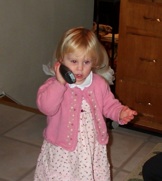
Later when  2 1/2 year old Gwyneth came inside I read one of  her favorite books that her mother often reads to her: Are You My Mother? When I periodically stopped reading and asked her what she  thought would happen next,  she would reply with a viable answer. When I came to the page with all the animals shown I would read, “No, I am not your mother, said the -----. I would get my mouth ready to pronounce the word but made no sound. She would invariably know the animal's name by looking at the formation of my mouth. No, I did not read them in the order as appeared in the book. 

After reading the book I asked her to tell me a story, she immediately replied, “Once upon a time there was a little girl who went swimming with her mother. She lost her mother... That was the same theme as Are You My Mother? but with different characters. 


The lesson is obvious.

Second

Oral lang., writing (from Early Learning Standards - not CC.)

4020-01 Standard I: Oral Language_Students develop language for the purpose of effectively

communicating through listening, speaking, viewing, and presenting.

4020-0101 Objective 1: Develop language through listening and speaking.

a. Identify specific purpose(s) for listening (e.g., to gain information, to be

entertained).

b. Listen and demonstrate understanding by responding appropriately (e.g., follow multiple-step

directions, restate, clarify, question, summarize).

c. Speak clearly and audibly with expression in communicating ideas.

d. Speak in complete sentences with appropriate subject-verb agreement.

4020-0102 Objective 2: Develop language through viewing media and presenting.

a. Identify specific purpose(s) for viewing media (i.e., to identify main idea and details, to gain information, distinguish between fiction/nonfiction).

b. Use a variety of formats (e.g., drama, sharing of books and personal writings, choral readings, informational reports, retelling experiences, and stories in sequence) in presenting with various

forms of media (e.g., pictures, posters, charts, ads, newspapers).

Fluency


4020-05 Standard V: Fluency_Students develop reading fluency to read aloud grade level text effortlessly without hesitation.

4020-0501 Objective 1: Read aloud grade level text with appropriate speed and accuracy.

a. Read grade level text at a rate of approximately 80 wpm.

b. Read grade level text with an accuracy rate of 95-100%.

4020-0502 Objective 2: Read aloud grade level text effortlessly with clarity.

a. Read grade level text in three- to four-word phrases using intonation, expression, and punctuation cues.

b. Read with automaticity 200 second grade high-frequency/sight words.

Children’s creativity needs to be nurtured.

Eleanor is showing her book made in pre-school

Here is a letter Eleanor wrote as a 5th grader when she took upon herself along with two other friends to help the hungry.

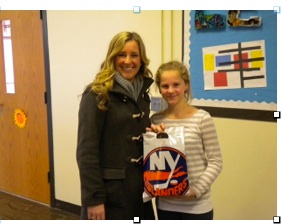
Eleanor, on her own,  called the Sound Tigers Hockey organization and drafted the following email:

“Hi, my name is Ellie.... and I am a fifth grade student from ....Elementary school in..... CT. At school, I am part of a gifted program called T.A.G which has partnered with the CT Food Bank to do various services that help the hungry. My partners and I thought it would be cool to raise money for the CT. Food Bank, but in a fun way to raise money for the CT Food Bank. That is when I saw your website that provides ticket programs, and knew that doing a raffle with these tickets would be a great way to raise money for the CT Food Bank. So I talked to my partners, Anna... and Catie... about the idea in which they agreed.

At my school my partners and I would sell raffle tickets, and all the money we received would go straight to the Connecticut Food Bank. At school we would print flyers and make an announcement on the intercom about the raffle. After two weeks we will pick a winner. My partners and I are asking that the date of the game for the tickets will be a mid January game so we can do a raffle at our school.

To contact me, my email is... and my phone number is... If you would like to contact my T.A.G. teacher, Cathy..... her email is...

11/14/13     Here is the response Eleanor received.

The Public Relations for the hockey team went to Eleanor’s school and presented her with a bag of goodies she could use to raffle off or use as a door prize.


Eleanor’s mother reading to her every night from a baby on, had a tremendous influence on Eleanor’s academic career.

Constructed by Mary DeFalco  Updated 4 /1/19

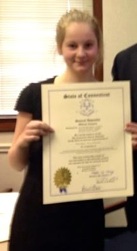
In 6th grade Eleanor received the State’s honor - First Award in the essay-writing contest.


In 7th received the First honors award at her school for her oral presentation entitled “Hunger and Women.”


Summer of her 7th grade, she attended a camp for gifted students at Yale University.


I attribute her skills to the family reading through the years. 


Summer of her sophomore year she attended Brown University and enrolled in a philosophy course.


Research has demonstrated that the most effective read-alouds are those  in which children are actively involved asking and answering questions and making predictions rather than  passively listening...

The first read-aloud includes four components: book introduction, voc. support techniques, analytical comments & questions, and an after reading “why” questions.

Lea M. McGee & Judith A. Schickendanz

in 5/2007 The Reading Teacher